Every organization maintains its identity across dozens of surfaces: the website, Google Business Profile, LinkedIn, industry directories, press coverage, and review platforms. Humans connect those references intuitively. Search systems and AI models must reconcile them, and inconsistencies weaken their confidence in who a brand is and what it does.
Organization schema addresses that problem directly. It is structured data that states, in machine-readable form, the official identity of an organization and the properties and profiles that belong to it. For marketing teams, it is the foundation of entity clarity.
What Organization Schema Does
Organization markup is a JSON-LD block, typically placed on the homepage or About page, that declares the organization’s official name, URL, logo, contact details, identifiers, and authoritative external profiles.
Google’s Organization structured data documentation explains that this markup helps Google understand an organization’s administrative details and disambiguate it in search results. In practical terms, it confirms that the logo, phone number, and LinkedIn profile all belong to the same entity.
It does not guarantee a knowledge panel or improved rankings. It reduces ambiguity, which supports accurate representation across organic results, local results, and AI-generated descriptions of the brand.
For marketing leaders, the practical implication is ownership. Organization markup is effectively the brand’s official record for machines, and it should be governed with the same care as brand guidelines, press boilerplate, and executive bios. When the business changes, the markup should change with it.
Essential Organization Schema Properties
Not every property is required. Prioritize those that describe the organization accurately and that it is prepared to maintain.
name. The official organization name, exactly as used across other channels.
alternateName. Recognized variations, such as acronyms or former names.
url. The primary website address.
logo. A crawlable, indexable logo image that remains legible at small sizes.
description. A concise statement of what the organization does and for whom.
address. The public business address, where applicable.
telephone and email. Primary contact channels.
contactPoint. Department-specific contacts, such as sales or support.
sameAs. URLs of official, actively maintained profiles: LinkedIn, YouTube, Facebook, Google Business Profile, and authoritative industry listings.
Formal Identifiers
Organization markup also supports formal identifiers that strengthen verification, including legalName, taxID, vatID, duns, leiCode, naics, and iso6523Code. Include only identifiers that genuinely apply and that the organization is comfortable publishing. For government contractors, alignment between these values and SAM.gov registration data is particularly valuable.
Common Consistency Errors
Most Organization schema issues are governance failures rather than syntax errors.
- Name variations. “Ridgeline Advisors LLC” in markup, “Ridgeline” on Google, and “Ridgeline Advisory Group” on LinkedIn. Define one primary name and declare the others as alternate names.
- Outdated contact data that no longer matches the website or Business Profile.
- Broken logo URLs following redesigns or media library cleanup.
- Unofficial or dormant profiles listed in sameAs.
- Conflicting markup from a theme, SEO plugin, and schema plugin each emitting separate Organization entities.
- Marked-up details not visible on the page.
An Audit Process for Marketing Teams
- Validate the homepage with Google’s Rich Results Test and the Schema Markup Validator.
- Confirm that only one Organization entity is output, or that multiple entities are intentionally connected.
- Reconcile every value against the website footer, Business Profile, and social profiles.
- Verify that each sameAs link resolves to an official, maintained profile.
- Re-audit after redesigns, plugin changes, mergers, or rebrands.
Why This Is a Marketing Responsibility
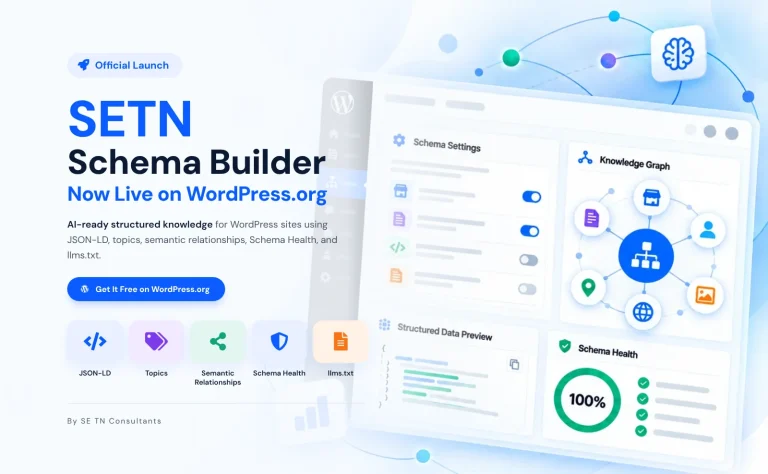
Entity consistency is brand governance applied to machine-readable data. As AI systems increasingly summarize organizations rather than simply linking to them, the accuracy of those summaries depends on clear, consistent signals. Organization markup is the foundation SETN Consultants builds every structured data engagement on, and it is why the SETN Schema Builder plugin models connected entities rather than isolated snippets.
Frequently Asked Questions
What is Organization schema?
It is structured data, usually in JSON-LD, that describes an organization’s official name, website, logo, contact details, identifiers, and authoritative profiles in a format search systems can interpret.
Where should Organization schema be placed?
Typically on the homepage or About page. It should be declared once and can be referenced by other pages.
What does sameAs do?
The sameAs property lists URLs of official profiles representing the same organization, helping search systems connect those references to one entity.
Does Organization schema improve rankings?
Not directly. It improves identification and disambiguation, which supports accurate representation in search and AI experiences.
Check your Organization schema with SETN Consultants and make sure search systems see one clear, consistent brand: https://setnconsultants.com/setn-schema-builder/