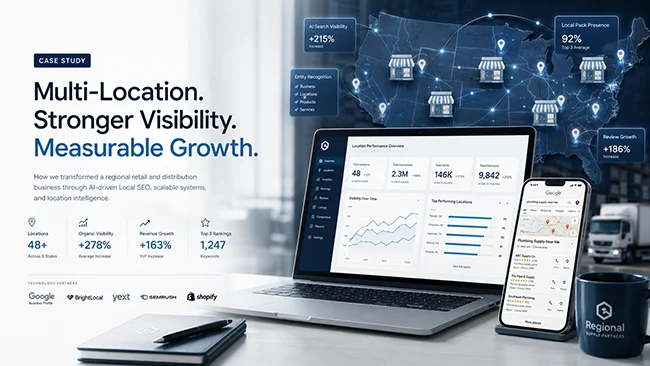
For businesses that operate across multiple locations, local SEO isn't a single campaign — it's a system. And most multi-location businesses are leaving significant visibility on the table because they treat it like a one-time setup rather than an ongoing strategy.
Here's what effective local SEO looks like for businesses that operate in multiple markets.
Why Multi-Location Local SEO Is Different
A single-location business needs one well-optimized Google Business Profile, one strong location page, and a consistent local citation strategy. Straightforward enough.
A multi-location business needs all of that — multiplied — and it needs it to be consistent, non-duplicative, and distinctly optimized for each market rather than copy-pasted.
Copy-paste is the most common mistake we see. And it actively hurts performance.
The Four Pillars of Multi-Location Local SEO
1. Individual Google Business Profiles
Each location needs its own Google Business Profile with accurate, complete, and unique information — including location-specific services, hours, photos, and a regular cadence of posts and review responses.
A single corporate profile doesn't serve local customers looking for the nearest location. Separate, well-maintained profiles for each location do.
2. Dedicated Location Pages
Your website should have a unique page for each location — not a directory-style list page, but an actual page with local context, local testimonials if available, local service details, and embedded map information.
These pages should be written differently from each other, reflecting the specific community and customer base of each location.
3. Consistent Business Listings
Name, address, and phone number (NAP) consistency across Yelp, Bing, Apple Maps, industry-specific directories, and other platforms is a foundational local SEO signal. Inconsistencies create confusion for search engines and customers alike.
4. Review Generation by Location
Reviews need to be collected and managed at the individual location level. A customer reviewing a specific location doesn't help a different one. A systematic approach to requesting and responding to reviews at each location compounds authority over time.
What We've Seen in Practice
When we've audited multi-location businesses, the most common issues are: duplicate content across location pages, inconsistent NAP data across directories, inactive or sparse individual Google Business Profiles, and no location-specific review strategy.
Addressing these systematically produces measurable improvements in local pack visibility — often within 60 to 90 days for locations that were significantly underoptimized.
Is Your Multi-Location Strategy Working?
If you're not sure whether your locations are performing as well as they could in local search, we'd be glad to take a look. A local search footprint audit is often the fastest way to identify where visibility is being left behind.